
Home / Treatments / Eyelid surgery
Face
Eyelid surgery – an open gaze, your own eye shape
Drooping eyelids make the whole face look tired – even when you feel well rested. An upper or lower eyelid correction is a comparatively minor outpatient procedure with a clear effect on your facial expression.
Hardly anything shapes our facial expression as strongly as the eyes. When the skin of the eyelids droops, the gaze looks older, strained and sometimes sad – even though you feel fresh.
A procedure I perform very frequently
Eyelid surgery is one of my most frequent operations: every year I perform more than 200 eyelid procedures. I value this procedure because a comparatively small intervention can have a great effect on your overall appearance.
There is no standard approach. Eyelid shape, excess skin and fat pads differ from person to person, which is why I plan every eyelid procedure individually. Your eye shape is preserved – you should still recognise yourself in the mirror.
Upper eyelid surgery
Upper eyelid surgery (upper blepharoplasty) may be considered when the eyes look smaller and tired, or when the skin of the upper eyelid presses on the lashes (“hooded eyelids”). In pronounced cases, the field of vision may even be restricted.
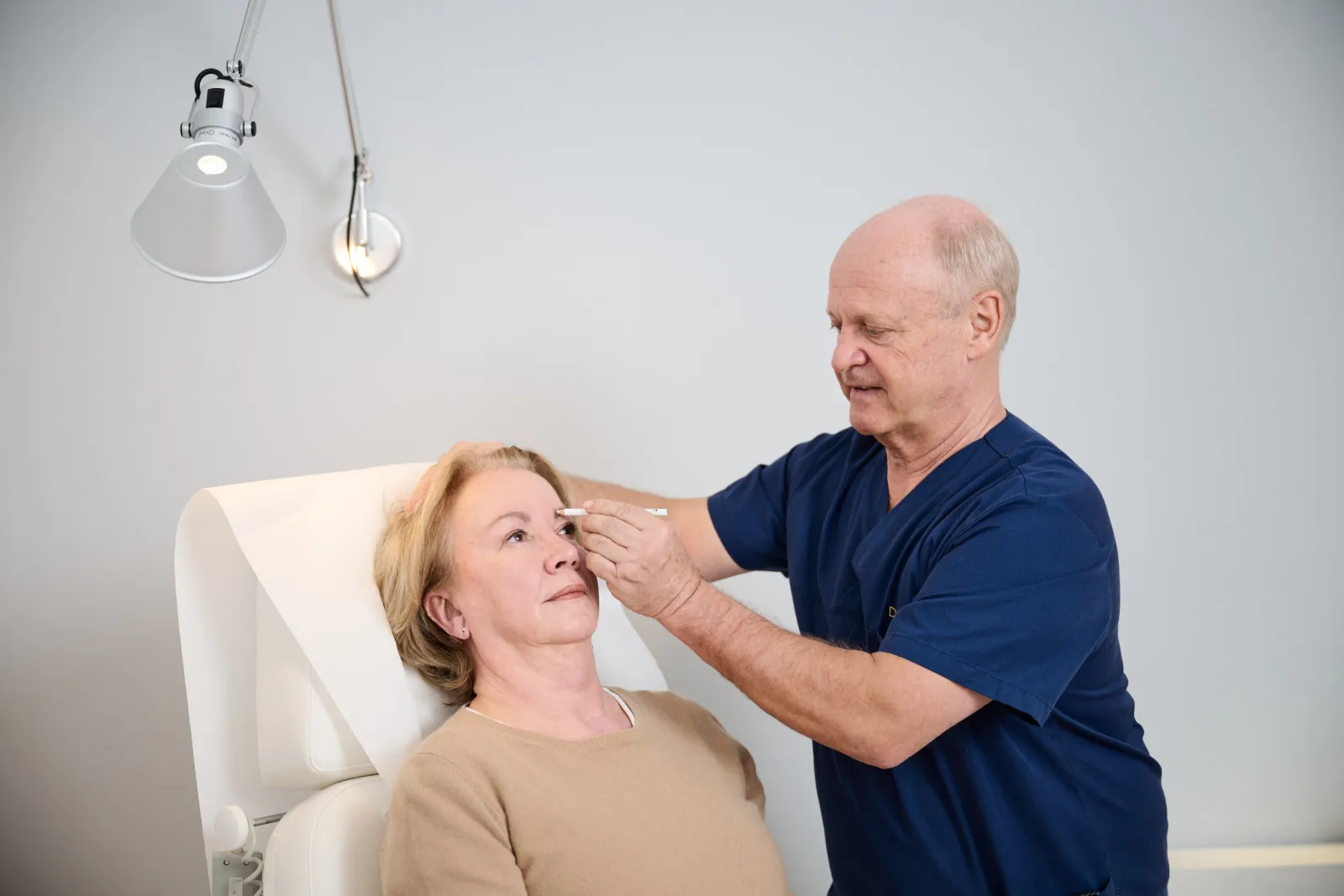
I remove the excess skin and, if necessary, part of the muscle or fatty tissue. The strip of skin to be removed is marked precisely before the operation while you are sitting up, so that both sides become symmetrical. The incision lies in the natural eyelid crease and tapers off at the side in a fine laughter line; it is closed with very fine sutures. Excess fat from the upper eyelid can, if required, be reused elsewhere, for example for shadows under the eyes.
Lower eyelid surgery
On the lower eyelid, the issue is usually bags under the eyes, slack skin or dark shadows caused by protruding fat pads. A lower eyelid correction is more complex than upper eyelid surgery and requires many years of experience, including in reconstructive surgery. There are two approaches:
- From the outside: The incision lies directly below the lash line and extends a few millimetres into the lateral laughter line. This allows excess skin, bulging fat and slack muscles to be treated together; fat can also be redistributed to smooth the transition to the cheek.
- From the inside via the conjunctiva: For pure bags under the eyes without excess skin, the fat is removed via the inside of the eyelid – without a visible scar.
On the lower eyelid, less is often more: if too much fat is removed, the eyes look hollow; if too much skin is removed, the eyelid can be pulled downwards.
What you can expect
- An outpatient procedure of no more than 90 minutes
- Inconspicuous scars in the natural eyelid crease
- No change to the shape of your eyes
- A long-lasting result
When particularly careful planning is needed
Dry eyes, several previous operations, connective tissue disorders or very high expectations call for particularly thorough assessment. With dry eyes, an examination by an ophthalmologist before the procedure is important. Glaucoma does not rule out eyelid surgery, but it does require close monitoring.
Sometimes the actual cause does not lie in the eyelid at all, but in a sagging eyebrow. I always check this during the examination – more on this under Neck and brow lift.
Procedure: preparation, operation, aftercare
Eyelid surgery is a manageable procedure, and healing can be planned well. Where the procedure takes place is something we discuss during the consultation.
- 011–3 weeks beforePreparation
Examination of the eyelids, planning and informed consent; medication is discussed.
- 02day of surgeryOperation
outpatient operation of no more than 90 minutes; afterwards home with someone accompanying you.
- 031–2 weeksAftercare
Cooling, removal of stitches after a few days; swelling usually subsides within one to two weeks.
Preparation
- For about two weeks beforehand, no blood-thinning painkillers such as ASA (acetylsalicylic acid), ibuprofen or diclofenac – only after consulting a doctor.
- Avoid nicotine, alcohol and sunbeds during this time if possible; pause dietary supplements shortly before the procedure.
- Have glasses ready instead of contact lenses for the first few days.
- Arrange for someone to accompany you home – you cannot drive yourself on the day of surgery.
The day of surgery
- Marking The strip of skin to be removed is marked precisely while you are sitting up.
- Anaesthesia We discuss the type of anaesthesia beforehand.
- Operation On the upper eyelid through an incision in the eyelid crease; on the lower eyelid, depending on the findings, through an incision just below the lashes.
- Completion Fine sutures, followed by cooling.
- Going home After a short rest, you go home with someone accompanying you.
Healing at a glance
- Day 1–3Cooling, keeping the head raised, resting the eyes; slight bruising is normal
- Day 5–7the stitches are removed; many people now feel comfortable in public again
- Week 2swelling and discolouration have usually largely subsided; make-up after consultation
- Week 3–4sport and contact lenses possible again after consultation
- Month 3the scars in the eyelid crease are barely visible
The result is visible almost immediately and looks more natural with every day as the swelling goes down. Sunglasses offer protection in the early days and conceal at the same time. You can usually work at a screen after a few days – with breaks, because the eyes tire more quickly at first.
Get in touch immediately if you experience visual disturbances, severe or increasing pain, a tense swelling or fever.
Risks
Eyelid surgery is considered a comparatively low-risk procedure. Possible complications include, among others, secondary bleeding, wound healing problems, temporarily dry eyes, asymmetries and – particularly on the lower eyelid – malposition of the eyelid margin. This is precisely why experience matters. I discuss all risks with you in detail before the procedure.
Frequently asked questions
Will health insurance cover upper eyelid surgery?
Generally not, because it is an aesthetic procedure. If the excess skin demonstrably restricts the field of vision, the procedure may be medically justified. The basis is usually a visual field test by an ophthalmologist; please clarify cost coverage with your health insurer before the treatment.
Is the procedure painful?
The operation itself is painless. Afterwards, there is usually only minor discomfort, which can be treated well with standard painkillers.
Is the eye itself touched?
No. The operation is performed on the skin, muscle and fatty tissue of the eyelid, not on the eyeball. Vision may be slightly blurred for a while because of ointment or slight swelling of the conjunctiva.
Can I have my upper and lower eyelids done at the same time?
Yes, that is often possible. Whether it makes sense is something we decide after the examination. A combination with a facelift can also produce a harmonious overall appearance.
When will I be socially presentable again?
Many people feel comfortable in public again after about a week. How pronounced the swelling is varies from person to person.
When can I do sport again?
Light exercise after about two weeks; intensive sport after lower eyelid surgery no earlier than after around four weeks.
When are the stitches removed?
Generally after about five to eight days – this is also the first detailed check-up.