
Home / Treatments / Facelift
Face
Facelift – looking refreshed, not changed
When the cheeks, jawline and neck lose their firmness, the cause lies in the deeper tissue layers. A modern facelift works precisely there – with the aim of making your face look fresher while remaining entirely your own.
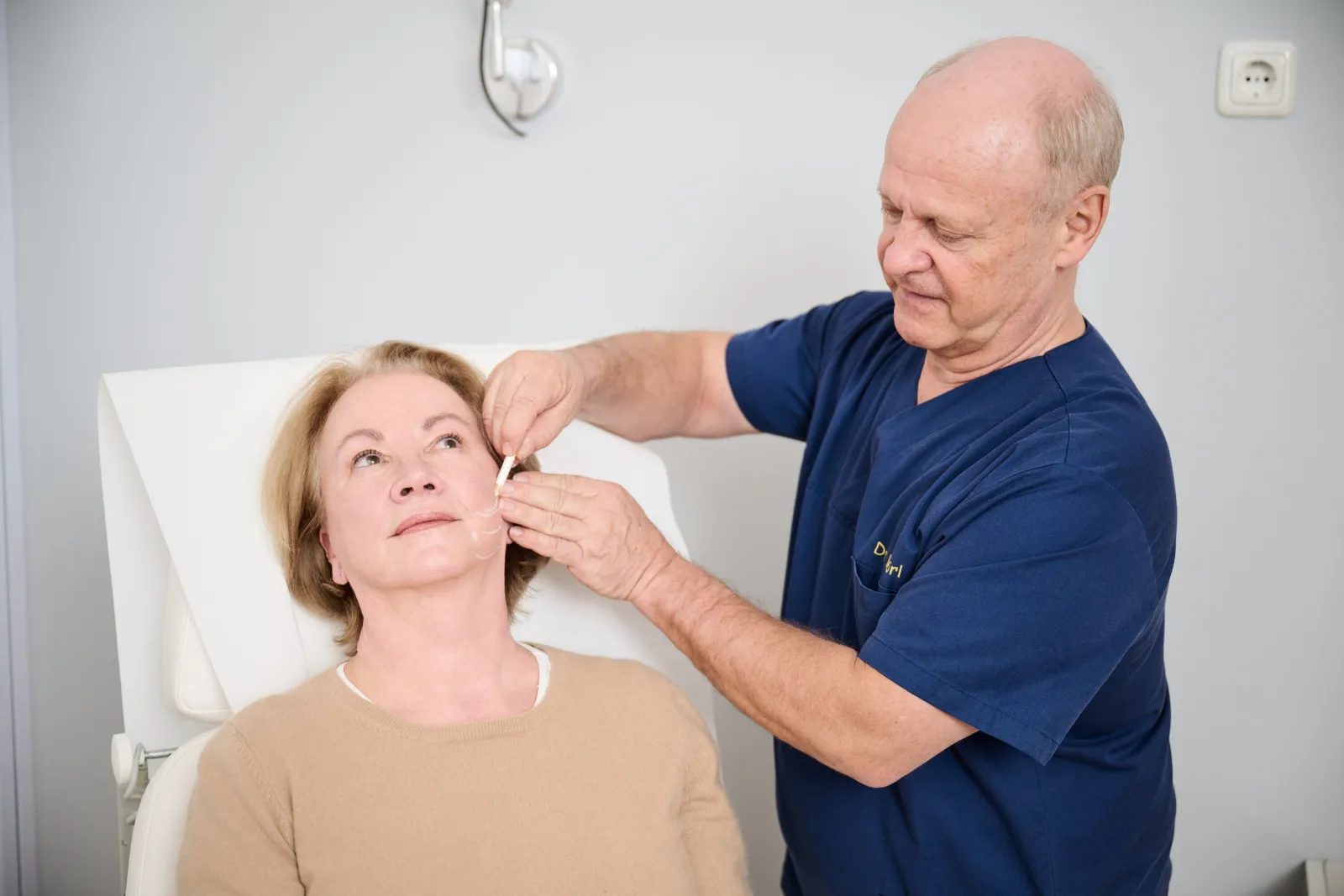
Over the years, the face loses its elasticity. The cheeks sag, the jawline softens and wrinkles appear on the neck. Creams and fillers reach their limits here, because the problem lies not in the skin but beneath it.
Why the face is my main focus
For many years, my clinical and scientific focus was craniofacial surgery. This speciality corrects complex changes to the bones and soft tissues of the skull and face – congenital malformations, the consequences of accidents, reconstruction after tumour operations. Professor Mühlbauer entrusted me with heading this sub-department as senior consultant.
Anyone working there has to know the course of the nerves, blood vessels and connective tissue layers of the face very precisely. Today, this knowledge benefits every aesthetic procedure – from the mini-lift through midface and neck lifts to the classic deep-plane facelift.
The principle: deep-plane SMAS
Older methods mainly tightened the skin. The result often looked taut and did not last long, because skin under tension gives way.
With the deep-plane SMAS technique, I instead return the deeper tissue layers to their former position. SMAS stands for “superficial musculoaponeurotic system” – a layer of connective tissue that supports the face like a net. If it is released at the right point and re-anchored, the skin follows without tension.
- A natural expression instead of taut skin
- Facial expressions are preserved
- Cheeks, jawline and neck are treated together
- The scars lie in natural skin creases and along the hairline
Who a facelift may be suitable for
A facelift can make sense when sagging areas of the face, deep wrinkles and lost contours dominate the picture – for example jowls, an indistinct jawline or pronounced nasolabial folds. What matters is not your age, but the findings, your health and your expectations.
Not every concern requires an operation. Sometimes an eyelid correction, a neck lift or a wrinkle treatment is enough. I will tell you that openly, too.
A successful facelift does not stand out – it simply looks right.
Which variant? An overview
“Facelift” is an umbrella term for procedures of very different extent:
- Skin tightening with a short incision (often called an “S-lift”): incision in front of and around the ear; mainly the skin and subcutaneous tissue are tightened. Suitable for mild sagging, often possible under local anaesthetic, short recovery – although the effect is more limited.
- SMAS and deep-plane lift: in addition to the skin, the supporting layer of connective tissue and muscle is lifted. This is the right approach when the cheeks, jawline and neck have sagged together.
- Midface lift: sagging cheek tissue is lifted through an incision just below the lashes, often together with a lower eyelid correction.
- Neck, forehead and brow lift: these complement the facelift or are used on their own – see Neck and brow lift.
Terms such as “mini”, “midi” or “maxi lift” are not uniformly defined. What matters is which layer is tightened, where, and to what extent.
Sensible combinations
A facelift tightens and repositions, but does not replace lost volume. It can therefore be complemented well – with autologous fat for hollow areas, with eyelid surgery or with injectable fillers for fine lines.
When I am cautious
In the case of serious acute illness, a procedure is postponed. Caution is advised if there is a tendency towards raised (hypertrophic) scars – and if expectations go beyond appearance, for example solving personal problems. We talk about this openly, too.
Procedure: preparation, operation, aftercare
A facelift can be planned well. The following steps show the typical course; we determine your personal plan – including where the procedure takes place – during the consultation.
- 01a few weeks beforePreparation
Consultation, examination, planning and informed consent with time to reflect. Medication and smoking are discussed.
- 02day of surgeryOperation
Deep-plane facelift under general anaesthetic; afterwards generally one to two nights as an inpatient.
- 03weeks to monthsAftercare
Check-ups and removal of stitches; swelling subsides, the final result becomes apparent after a few months.
Preparation
- Photos from younger years help us to define the goal together.
- Preliminary examinations such as a blood count and, if necessary, an ECG – depending on age and state of health, for example through your GP.
- Blood-thinning medication (such as painkillers containing acetylsalicylic acid) should only be stopped around two weeks beforehand after consulting a doctor.
- Nicotine and alcohol should be avoided if possible for at least two weeks before and after the operation – this significantly reduces the risk of healing problems.
- Organisation: plan for someone to accompany you on discharge, time off work and help at home for the first few days.
The day of surgery
- Arrival You arrive with an empty stomach, and any last questions are discussed.
- Marking The incision lines and treatment zones are marked while you are sitting up.
- Anaesthesia The facelift is performed under general anaesthetic; we decide on the type beforehand with the anaesthetist.
- Operation Through inconspicuous incisions in front of and behind the ear, the deep tissue layer is released and repositioned together with the sagging areas. Excess skin is removed without tension.
- Afterwards A light head bandage protects the wounds. For a classic facelift, I recommend one to two nights as an inpatient.
Healing at a glance
- Day 1–2Cooling, keeping the upper body raised, checking the wounds, discharge
- Week 1Swelling and bruising are at their most pronounced and then subside; the stitches are removed after a few days
- Week 2usually socially presentable again (after 10–14 days); slight swelling can be concealed
- Week 4–6Sport, sauna and intense sun possible again after consultation
- Month 3–6subtle swelling has subsided, the scars fade – the result has matured
Cooling, sleeping with the upper body raised and physical rest support healing. The natural ageing process continues – but a well-performed facelift has an effect over many years.
Get in touch immediately if one side swells considerably more than the other, the pain suddenly increases, you develop a fever or a wound weeps or becomes red.
Risks
Every operation carries risks. In the case of a facelift, these include, among others, secondary bleeding and bruising, wound healing problems, conspicuous scars, temporary sensory disturbances and – rarely – injury to facial nerves. Smoking, certain medications and pre-existing conditions increase the risk. This is why a confident command of the surgical technique and precise anatomical knowledge are so important. In the informed consent discussion, we go through each point individually.
Frequently asked questions
At what age does a facelift make sense?
There is no “right” age. What matters are the findings, the quality of the tissue and your state of health. In the consultation, I clarify whether a facelift or a smaller procedure suits you better.
Will I look “operated on” after a facelift?
That is exactly what the deep-plane technique is meant to avoid. Because the deeper layers rather than the skin are tightened, the expression remains natural. The aim is for you to look refreshed – not changed.
How long does a facelift last?
That depends on the tissue, lifestyle and predisposition. A facelift does not stop ageing, but it does, in a sense, turn back the clock. Many patients benefit from it for ten years and longer.
When will I be socially presentable again?
Usually after 10 to 14 days. For important appointments, you should allow a little more of a buffer.
What scars remain?
Depending on the technique, the incisions run along the hairline at the temple, in the natural crease in front of the ear and behind the ear. They generally fade to fine lines.
How long does the operation take?
That depends on the extent, for example whether the neck or eyelids are treated at the same time. I will tell you the expected duration during planning.
Will I be in a lot of pain after the facelift?
Most people experience a feeling of tightness and numbness rather than severe pain. You will be given painkillers to take home.
What is a “non-surgical facelift”?
This refers to non-surgical methods such as fillers, autologous fat, thread lifts or focused ultrasound. For mild findings they can achieve a great deal; with clearly sagging tissue and excess skin, they do not replace an operation.
Will health insurance cover a facelift?
A facelift for aesthetic reasons is generally paid for neither by basic health insurance (KVG) nor by supplementary insurance. After the consultation, you will receive an individual cost estimate.