
Home / Treatments / Liposuction
Body
Liposuction – shaping contours, not losing weight
Some fat deposits remain despite exercise and a mindful diet. Liposuction removes them in a targeted way that is gentle on the tissue – to improve the body contour, not to reduce weight.
Fat deposits on the hips or buttocks, on the upper arms or thighs: when your proportions have changed, this is often due to fat deposits that barely respond to exercise and diet. This is where liposuction can help.
Typical areas
In women, these are often the so-called saddlebags – fat deposits on the thighs, hips and inner knees with a rather slender upper body. Men are often bothered by accumulations of fat on the hips or chest. Other common areas are the abdomen, flanks, upper arms, chin and neck.
I only remove as much fat as is needed for a harmonious silhouette – for example, for a flowing transition from the thighs to the hips or from the hips to the abdomen.
Who liposuction is intended for
Liposuction shapes; it is not a method for losing weight. It is suitable for localised fat deposits that remain despite diet and exercise, even at a normal weight. The fat between the organs in the abdominal cavity cannot be removed by suction – in cases of severe overweight, weight reduction therefore comes first.
The best results are achieved with a stable weight and good skin elasticity.
My approach
I perform liposuction under general anaesthesia combined with tumescent local anaesthesia. Before the suction, a solution of saline, a local anaesthetic and a vasoconstricting additive is introduced into the fatty tissue. It loosens the tissue, reduces bleeding and lessens the pain after the procedure; once introduced, it needs a certain amount of time to take effect. I have also studied the particular features of this technique scientifically, including in a conference paper on liposuction using the tumescent technique and local anaesthesia (2001).
Fine suction cannulas and vibration techniques are gentle on the tissue. The cannulas are inserted through a few very small incisions; visible scars are hardly to be expected.
How much at once?
Only a limited amount is removed per session. If larger amounts are needed, it is safer to spread them over two procedures a few weeks apart. Liposuction of up to 6 litres is predominantly performed on an outpatient basis.
Contraindications
No surgery is performed during pregnancy. In the case of vascular diseases, previous thromboses or serious general illnesses, we decide on a case-by-case basis.
If lipoedema is involved, the diagnosis, approach and question of costs differ considerably – there is a separate page on this: Lipoedema.
Process: preparation, procedure, aftercare
Careful planning of the areas is crucial. This is how the procedure typically runs; we decide on the place of the procedure during the consultation.
- 01a few weeks beforePreparation
Defining the areas, assessing fat distribution and skin elasticity, preliminary examinations and an informed-consent discussion with time to reflect.
- 02day of surgeryProcedure
General anaesthesia with tumescent local anaesthesia; suction through small access points using vibration technique.
- 03weeks to monthsAftercare
Compression garments, check-ups, lymphatic drainage if necessary.
Preparation
- No blood-thinning painkillers for about two weeks beforehand – only after consulting a doctor.
- Avoid nicotine, alcohol, sleeping pills and sunbeds as far as possible.
- Blood count and coagulation; in the case of pre-existing conditions, an assessment by an internist.
- The compression garments are fitted in advance so that they are ready immediately after the procedure.
- Arrange for someone to accompany you home and plan a few days of rest.
The day of surgery
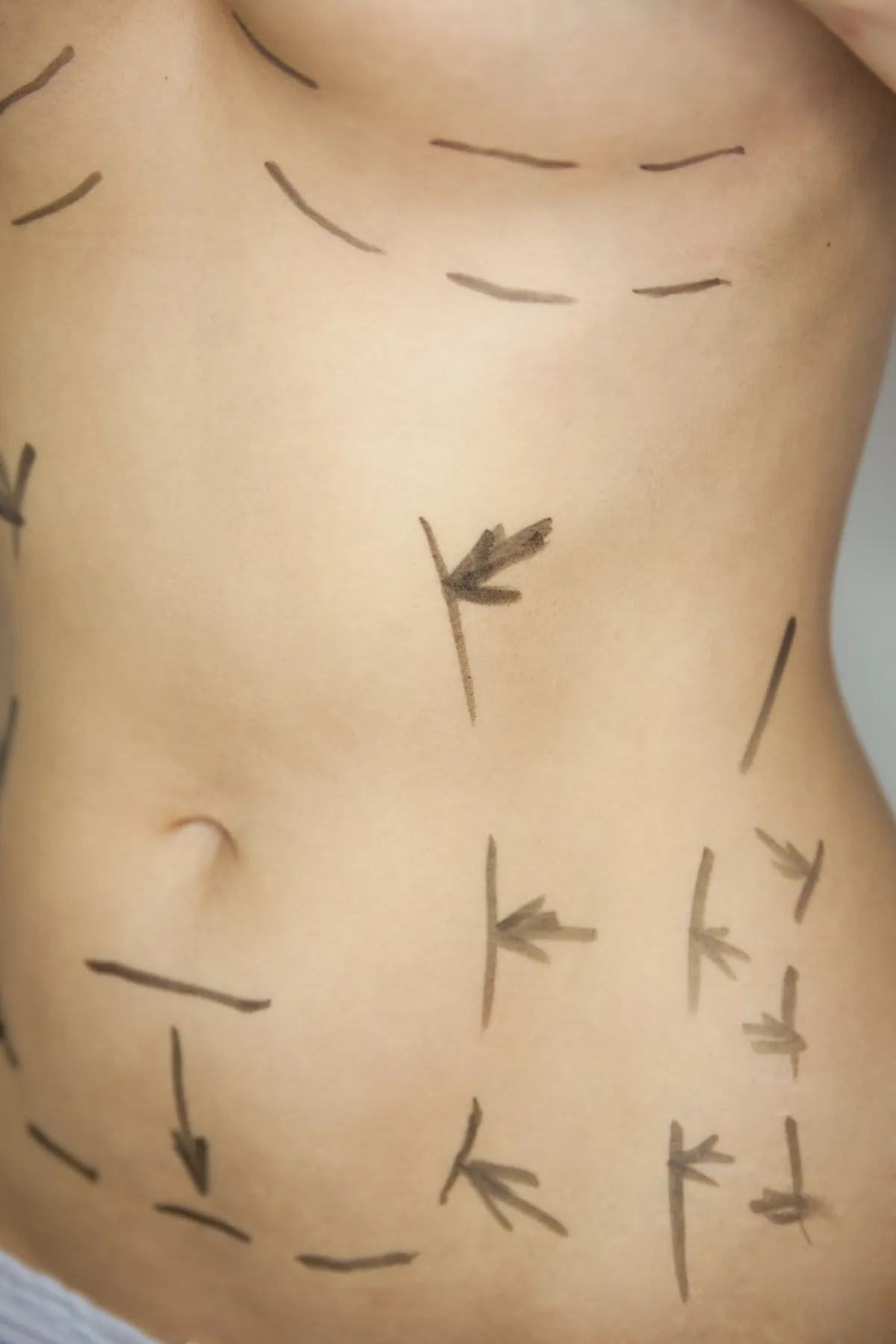
- Marking while standing The treatment areas are marked.
- Anaesthesia and tumescence The solution is introduced and takes effect.
- Suction Through a few small access points with fine cannulas and vibration technique.
- Compression The compression garments are put on immediately afterwards.
- Going home The procedure is often performed on an outpatient basis.
Healing at a glance
- Day 1–3a feeling similar to sore muscles, and swelling; tumescent solution may leak from the access points
- Week 1compression day and night; light movement promotes healing
- Week 2–4the swelling subsides; office work is usually possible again
- Week 4–6reduce compression as agreed; resume sport gradually
- Month 3–6the skin has settled – the new contour is visible
Swelling and bruising are normal in the first few days. Slight residual swelling may last three to five months; the final result becomes apparent after a few months. Absorbent pads for the first nights, drinking plenty and light movement help in the early period.
Contact us immediately if you have severe pain, fever, shortness of breath, a leg swollen on one side or redness around an access point.
Risks
Possible risks include bruising, seromas (accumulations of fluid), infections, sensory disturbances, unevenness of the skin surface and asymmetries. With larger suction volumes, the demands on monitoring and aftercare increase. We go through everything calmly in the informed-consent discussion.
Frequently asked questions
Will the fat deposits come back?
Fat cells that have been removed do not regenerate. With significant weight gain, however, the remaining fat cells can increase in volume. A stable weight is the best protection for the result.
Does the skin tighten after liposuction?
With good elasticity, the skin usually retracts well. With slack skin, additional tightening may be advisable – more on this under Body contouring.
When can I return to work?
For office work, often after a few days, depending on the extent and area. We discuss physically demanding work individually.
When can I do sport again?
Light sport is often possible after about three weeks – depending on the extent and healing.
Are there alternatives without surgery?
Cold, ultrasound, laser or radiofrequency procedures and injections are on offer. Their effect is usually considerably smaller and less predictable than that of liposuction – I will tell you that honestly.
Will health insurance cover liposuction?
Liposuction for aesthetic reasons is generally not covered by health insurance. After the consultation, you will receive an individual cost estimate.