
Home / Treatments / Breast surgery
Breast
Breast surgery – shape and proportion that suit you
Lift, reduction or augmentation: procedures on the breast call for an aesthetic sense and surgical experience. The aim is a result that fits naturally with your body shape – rather than following a trend.
After pregnancies or as elasticity decreases, the breast loses its firmness. Other women feel that their breasts are too large for their build and suffer from back and neck pain. Others again would like more volume. In all these cases, it is possible to achieve a breast shape that suits your silhouette.
I bring many years of experience to this – including from reconstructive breast surgery, which was an integral part of my training.
Breast lift
In a breast lift (mastopexy), I give the breast a firmer shape and a higher position. The skin envelope is reduced and the nipple is raised to the right position; the volume is largely preserved.
As a rule, I work with an internal bra: the body’s own glandular tissue is shaped and supported using a special suturing technique so that the breast is supported from within. This technique aims for a long-lasting result. How long the scars will be depends on how much the breast has sagged:
- around the areola for slight sagging
- around the areola and vertically downwards (“lollipop”) for moderate sagging
- additionally in the inframammary fold (“inverted T”) for severely sagging breasts
With a stable weight, a lift lasts many years; later, a further lift can be carried out via the existing scars. A lift can be combined with a reduction or augmentation.
Breast reduction
Very large breasts can be a real burden: shoulder and neck pain, grooves from bra straps, skin irritation in the inframammary fold, restrictions when doing sport. In a reduction, glandular, fatty and skin tissue is removed and the breast is reshaped. Often an incision around the areola and vertically downwards is sufficient; for very large, soft breasts, an additional incision in the inframammary fold is necessary.
I use methods that generally preserve nipple sensation and the ability to breastfeed. Because the tissue settles somewhat in the first few weeks, I deliberately shape the breast slightly higher during the operation than the eventual result.
If symptoms are pronounced, a breast reduction may be medically justified. Please clarify on a case-by-case basis before the treatment whether your health insurer will contribute.
Breast augmentation
Modern implants, computer-assisted planning and gentle surgical techniques characterise breast augmentation today. I use implants from established manufacturers. We choose the size, shape and position together so that the result suits your proportions.
- Shape: Round implants emphasise the upper pole of the breast; anatomically shaped ones often look more natural, but can rotate.
- Position: above or (partly) below the pectoral muscle – depending on the existing tissue.
- Access: usually in the inframammary fold, alternatively at the edge of the areola or in the armpit.
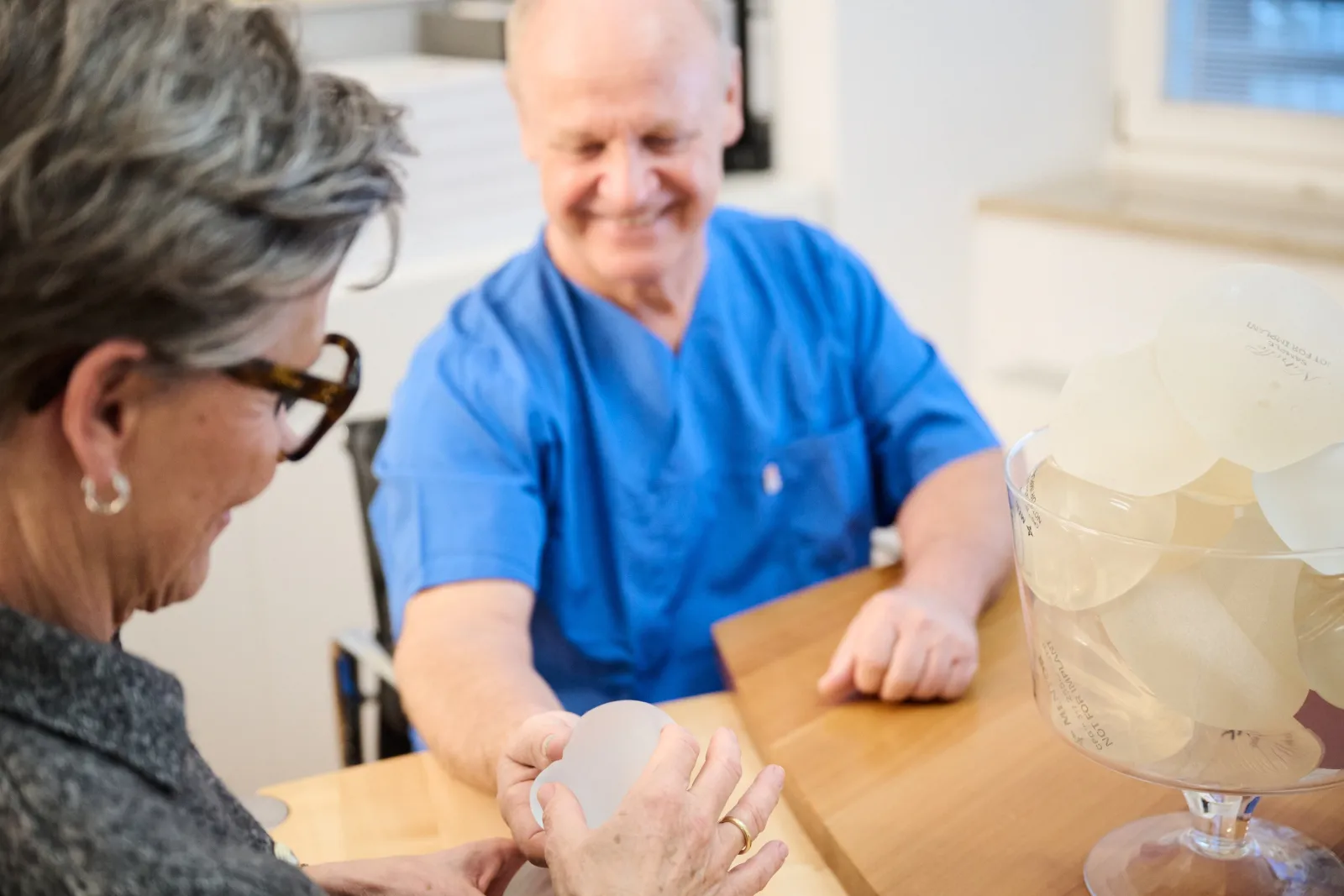
- Trying before deciding: During the consultation, different sizes can be compared using trial implants in a bra.
Implant or autologous fat?
Instead of an implant, augmentation with your own fat is also possible: fat is removed by liposuction from the abdomen, hips or thighs, processed and introduced into the breast. The method has its limits. The enlargement is moderate, part of the fat is reabsorbed, and sufficient fat reserves are needed. In addition, transplanted fat can make it more difficult to assess later mammograms. We discuss openly which approach suits you.
You can read about when an implant should be exchanged under Implant exchange and capsular contracture. For men: Male breast.
Procedure: preparation, operation, aftercare
Careful planning determines whether the result suits your body shape. The details depend on whether the breast is lifted, reduced or augmented; we determine where the procedure takes place during the consultation.
- 01a few weeks beforePreparation
Consultation, examination, breast imaging depending on age, planning of technique and incision lines, informed consent with time to reflect.
- 02day of surgeryOperation
Operation under general anaesthetic; followed by a support bra and care.
- 03weeks to monthsAftercare
Support bra, check-ups, gradual return to everyday life and sport.
Preparation
- Planning The technique, incision lines and – for an augmentation – the size and shape of the implant are determined.
- Preliminary examinations Depending on age and medical history, these include breast imaging and laboratory tests.
- Medication and smoking Only pause anticoagulants after consulting a doctor; stop smoking in good time.
- Informed consent detailed and with time to reflect – including on the ability to breastfeed and on sensation.
- Organisation Obtain a support bra as specified, have clothing with front buttons or zips ready, and plan for help during the first few days.
The day of surgery
- Marking The incision lines are marked while you are standing, so that the natural position of the breast is taken into account.
- Operation Depending on the goal, the glandular tissue is shaped, tissue is removed or an implant is inserted.
- Completion Fine sutures, dressing and support bra. Whether the procedure is carried out as an outpatient or with an overnight stay is something we discuss beforehand.
Healing at a glance
- Day 1–3Feeling of tightness and swelling; support bra day and night, do not raise your arms above your head
- Week 1–2Wound check, stitches are removed or trimmed; light activities possible
- Week 3–6Continue wearing the support bra, no heavy lifting
- from week 6Sport usually possible again – after consultation
- Month 3–12the tissue settles, the scars become lighter and softer
Get in touch immediately if you notice increasing swelling on one side, severe pain, fever, redness or wound discharge.
Risks
Possible risks include, among others, secondary bleeding, infections, wound healing problems, conspicuous scars, asymmetries and altered nipple sensation. With implants, there are additional implant-specific risks, such as capsular contracture. I inform you about all risks in detail before the procedure.
Frequently asked questions
Will I still be able to breastfeed after a breast reduction?
The methods I use aim to preserve the ability to breastfeed. There is no guarantee – we discuss this openly, especially if you are still planning to have children.
How long do breast implants last?
Modern implants are durable, but not made to last forever. Regular check-ups are part of it. When an exchange makes sense depends on the findings.
From what age is breast augmentation possible?
Purely aesthetic breast operations are only carried out from the age of 18. No operations are performed during pregnancy or breastfeeding.
When does the breast reach its final shape?
After about three months, the tissue has largely adapted; the final shape becomes apparent after up to a year.
Will I need drains after the operation?
Often not. If so, they are usually removed after about a day.
When can I do sport again?
Light exercise is possible again soon; intensive sport usually after six weeks. We determine the exact time during aftercare.